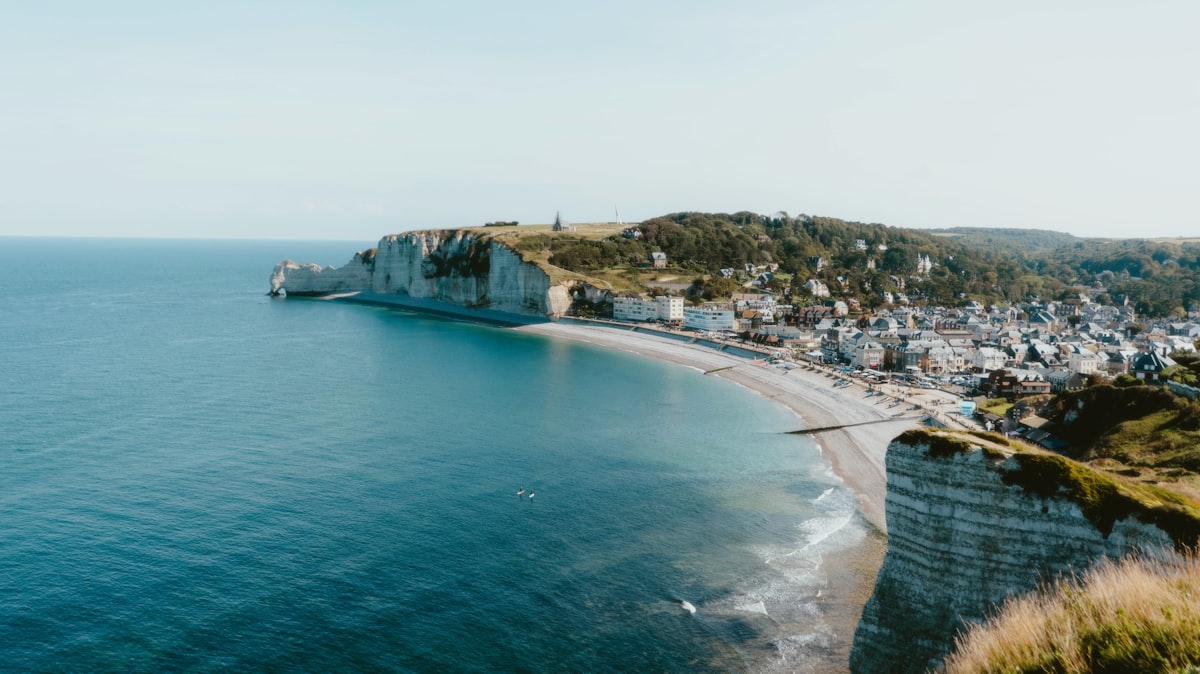
The Étretat cliffs, the D-Day beaches, Mont-Saint-Michel two hours away — Normandy is the richest stretch of coastline in France. A single weekend cannot cover it. Here is how not to waste the first one.
The Problem with Normandy
Normandy extends for 640 kilometres of coast between Mont-Saint-Michel and Le Havre. This is far too much for a weekend. The classic mistake of the first visit: trying to see everything in two days, arriving home exhausted and stuck in Sunday traffic with the feeling of having skimmed over everything and truly seen nothing.
The right strategy is to choose one area, inhabit it properly, and return the following year with the same approach.
Choosing Your Base
The Alabaster Coast: The Cliffs
From Étretat to Fécamp, the white chalk cliffs plunge directly into the sea. This is Normandy’s most dramatic coastline — and its most photographed, since Courbet and Monet worked here. Étretat itself is tourist-heavy, but the cliff path between the two towns, accessible on foot via the sentier des douaniers, is wild and vertiginous.
For: those who want dramatic scenery, landscape photography, coastal walking. Against: the beaches are pebble (no sand), the water is cold. Not ideal for swimming.
The D-Day Beaches: History
The coastline between Cherbourg and Bayeux carries the weight of June 1944. The memorials at Omaha Beach, the American Cemetery at Colleville-sur-Mer, the Utah Beach museum, the Pointe du Hoc — these are not tourist attractions in the ordinary sense. They require time and attention. A morning minimum; a full day if you approach them properly.
For: those with a serious interest in Second World War history. Against: the landscape itself is not spectacular. The interest is entirely historical.
The Côte Fleurie: Elegance
Deauville, Trouville, Cabourg — the resort coastline between the Seine estuary and the Orne. Belle Époque hotels, wooden promenades, horse racing, casino, Marcel Proust’s Balbec. This is the most curated, the most expensive, and (in its way) the most beautiful stretch of the Norman coast.
For: a comfortable, elegant weekend with good restaurants and beaches. Against: the most expensive of the three options by some margin.
Practical Realities
Normandy is two hours from Paris by train (Caen, Cherbourg, Rouen), two and a half by car. The TGV to Caen leaves from Paris Saint-Lazare roughly hourly. From Caen, the D-Day beaches are twenty to forty minutes by car; a rental is essential — Normandy is not a region navigable without one.
The weather is famously changeable. Pack for both sun and rain regardless of the forecast. The light after summer rain on the Alabaster cliffs is, incidentally, remarkable.
One Day, One Night, One Region: An Itinerary
Saturday morning: Arrive Caen or Bayeux by train. Pick up the rental car.
Saturday afternoon: Drive the D-Day coastline west to east: Pointe du Hoc, Omaha Beach, American Cemetery, Arromanches (for the remains of the Mulberry Harbour in the bay).
Saturday evening: Dinner in Bayeux — the best restaurant town in the region, proportional to its size. Book in advance in summer.
Sunday morning: Bayeux Tapestry (arrive before 10am; the queue is significant by midday). Cathedral.
Sunday afternoon: Drive north to Arromanches or Port-en-Bessin. Lunch by the sea. Return toward Paris.
This covers a coherent territory, properly. It leaves Étretat, Deauville, Mont-Saint-Michel, and the Cotentin Peninsula for subsequent visits. This is the correct approach.